Janice
All My Puny SorrowsJanice is a psychiatric nurse whose recurring presence in Elfrieda Von Riesen’s hospital stays makes her an important figure in the family’s efforts to care for Elfrieda. Her practical kindness—welcoming a returning patient, reassuring her sister, and making room for forms of expression beyond ordinary conversation—stands out against the less attentive encounters the family has with psychiatric care. Yet Janice is not able to resolve the central conflict: Elfrieda wants her suffering to end, while her family struggles to keep her safe and respect her choices.
Identity and Bedside Manner
Janice is already familiar to the family from earlier hospital visits. Outside work, she enjoys tango, which she explains in terms of the embrace. At work she wears light pink tracksuits and carries a small furry stuffed animal clipped to her belt loop, meant to help patients relax and smile. These details make her recognizable across admissions and give her a distinctive, approachable presence in settings that can feel impersonal to patients and relatives.
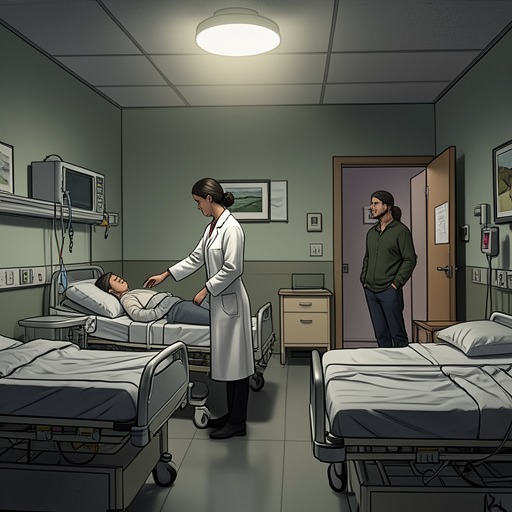
When she enters Elfrieda’s room, Janice greets her with a hug and says she is glad to see her but sorry to see her back in hospital. Elfrieda responds with an apology, but Janice redirects the exchange away from blame. She tells Elfrieda that she has not done something bad or wrong, and frames her actions as an attempt to end suffering. Janice’s response treats the crisis as a reason for care rather than a moral failure. She proposes beginning again and sits down beside the patient, turning reassurance into a willingness to stay in the conversation.
Her manner is compassionate without being effortless or sentimental. Elfrieda finds the nurse’s tone and words difficult to receive, and has to make herself meet Janice’s gaze. Janice nonetheless tries to engage her directly, while also acknowledging Yolandi Von Riesen’s worry. In another encounter, Janice tells Elfrieda that her brother had heard her perform in Los Angeles and had been deeply moved. Elfrieda does not offer the expected response; the resulting silence shows that Janice’s attempt at connection does not automatically make the patient’s feelings easier to express.
Care During an Earlier Crisis
Janice first meets Yolandi during an earlier emergency, after Yolandi has called for medical help when Elfrieda stopped eating and refused a doctor. Elfrieda had pleaded with Yolandi not to call, but Yolandi arranged for an ambulance. At the hospital, the sisters acknowledge the painful division between them: Elfrieda wants to die, Yolandi wants her to live, and their opposing aims coexist with love. Janice’s first visible act toward Yolandi is to ask to speak with her privately.
In a small family room, Janice gives Yolandi tissues and tells her she did the right thing by calling the ambulance. She also helps Yolandi understand that Elfrieda’s anger is directed at having her life saved, rather than proof that their bond has disappeared. Janice presents the feeling as something with distinguishable parts, a way of making a frightening, absolute rejection more comprehensible. She hugs Yolandi before leaving her alone. The exchange does not erase the sisters’ conflict, but it gives Yolandi support at a moment when she is crying and struggling with the consequences of acting against her sister’s wishes.
Janice’s care of Elfrieda is likewise attentive to how she communicates. When Elfrieda is reluctant to look at her, Janice persists in inviting her attention, but does not answer resistance with blame. Elsewhere, Janice is gathering paint tubes and rolls of paper for art therapy. She explains that some patients find it easier to express themselves through materials than through language. That approach matters in a story where Elfrieda’s silences and difficulty speaking can be mistaken for unwillingness to engage. The contrast with a psychiatrist who refuses to read what Elfrieda writes makes Janice’s recognition of nonverbal and written expression especially significant: she treats communication as something care must accommodate, not merely a test the patient must pass.
Explaining the Discharge Decision
When Elfrieda appears likely to leave the hospital, Yolandi fears that she is presenting herself as well in order to secure discharge. Janice tells the family that Elfrieda is expected to go home after seeing the doctor, and asks her directly whether she feels ready. Elfrieda says she wants to return to Nic and her ordinary life, is willing to take medication and arrange follow-up appointments, and appreciates the care she has received. Her response sounds rehearsed to Yolandi, who remains alarmed even as the family outwardly welcomes the news.
Yolandi follows Janice into the hallway to ask whether discharge is truly a good idea. Janice says she believes it is, while explaining that Elfrieda was admitted voluntarily and can leave when she feels ready. She describes the importance of allowing a patient to feel empowered by making consequential decisions. Yolandi points out the contradiction she sees: a patient may be allowed to make a major decision about leaving, while the family would not accept her making the decision to die. Janice understands the concern but says her hands are tied. She also notes that the hospital needs the bed and asks the family to give Elfrieda the benefit of the doubt. Her confidence that things may go well does not settle Yolandi’s fear; it exposes the gap between clinical procedure, limited resources, and a relative’s sense of continuing danger.
Narrative Role and Limits
Janice is a recurring figure of humane attention, not a rescuer with authority to control the outcome. Her interventions are small and particular: a greeting that avoids condemnation, a private conversation and hug for Yolandi, an effort to meet Elfrieda’s eyes, and a defense of expressive methods that do not depend on speech. These actions provide moments of recognition within a system that the family also experiences as hurried or dismissive.
The limits of Janice’s role are clearest in the discharge conversation. She can explain the voluntary status and the value placed on patient autonomy, but she cannot make the family’s competing obligations disappear or guarantee what will happen after Elfrieda leaves. Her compassionate approach therefore does not resolve the conflict between respecting Elfrieda’s agency and trying to protect her. Instead, Janice makes that conflict visible: care requires listening to Elfrieda as a person, even when those who love her fear what her choices may mean.